Designing a diagnostic copilot that keeps the physician thinking.
// Exploratory concept. Clinical data and reasoning are 100% illustrative, with no medical value or real diagnostic purpose.
Medical AI always sells the same promise: « it finds the right diagnosis ». That's the wrong problem. In a clinical setting, the failure to fear is automation bias — the moment a competent practitioner sees a confident display, stops exercising critical judgment, and follows. In medicine, that failure can kill.
So I inverted the objective. Not « what is the best answer? » but « how do you keep the physician reasoning while speeding up their work? » It's a cognitive-ergonomics problem before it's an AI problem — the intersection I've worked at for eighteen years.
End-to-end design direction and prototyping: problem framing, interaction principles, information architecture, three working screens. Prototypes built by directing agentic generation tools — I design, the tool executes. The approach itself is a demonstration of an AI-native workflow: designing agent interfaces by working with agents.
The agent always shows a differential. The screen structurally forbids premature conclusions.
Serious-but-rare diagnoses stay visible whatever their rank, until they're explicitly ruled out. Danger doesn't hide behind low probability.
Each hypothesis shows its discordant arguments. The interface shows what doesn't fit, not only what confirms.
The agent proposes the next discriminating question. It keeps the physician driving the reasoning.
Banning percentages, which manufacture false certainty. Qualitative relative weight, explicitly distinguished from a probability.
They confirm, suspect, pin, dismiss or force a hypothesis. The agent reorganises around their judgment — never the reverse.
A table where every hypothesis is readable at a glance. For each, the signs already gathered are set apart from the signs still to explore — the display becomes an interview aid. Signs are added on the fly, including through active listening: while the patient speaks, the differential re-weights in real time. Connected patient context, a « focus » panel per hypothesis, and a closing that writes to the record.
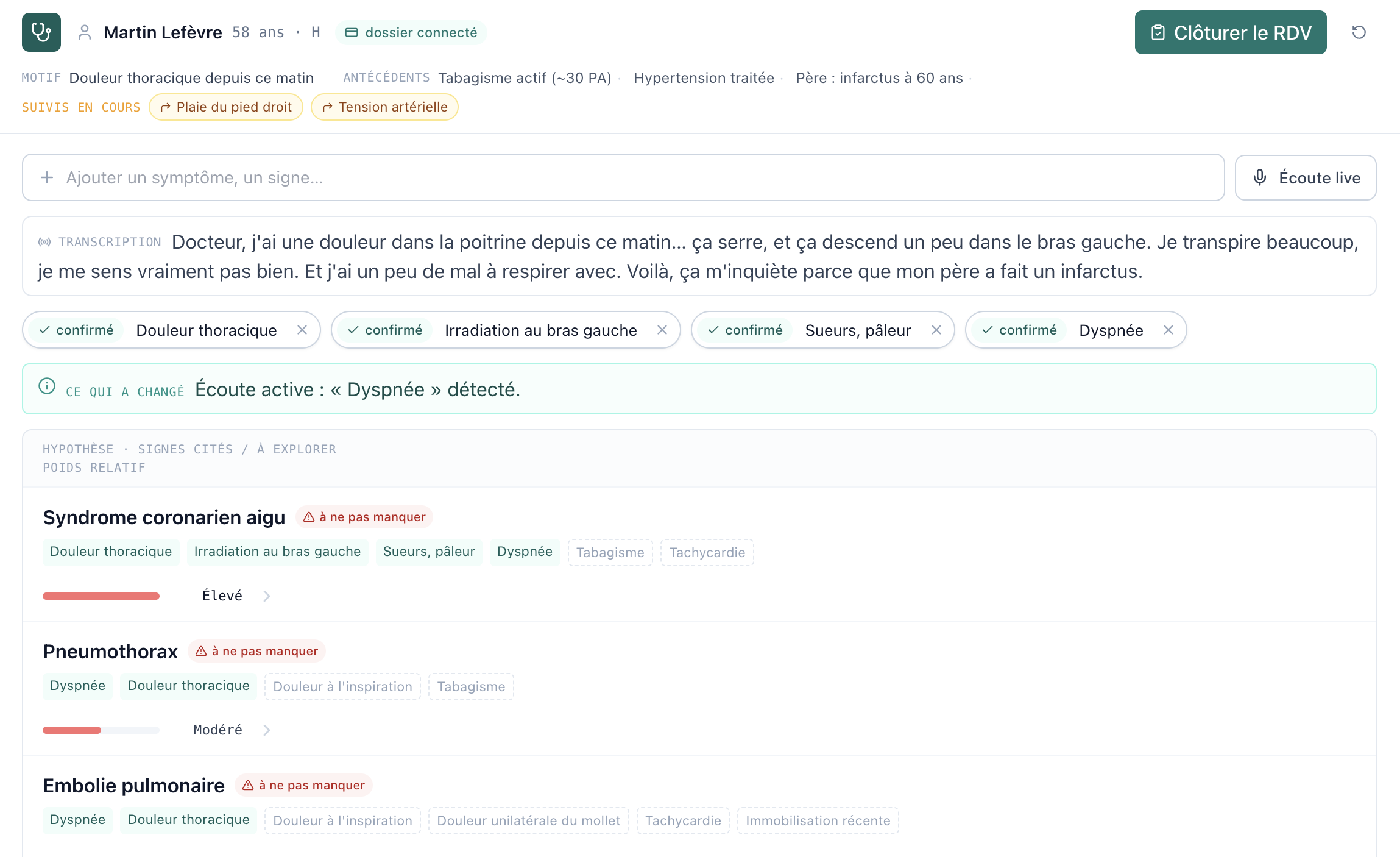
Combining instant reading (everything visible) with depth (focus panel) without overload. The table carries the essentials; detail is one click away.
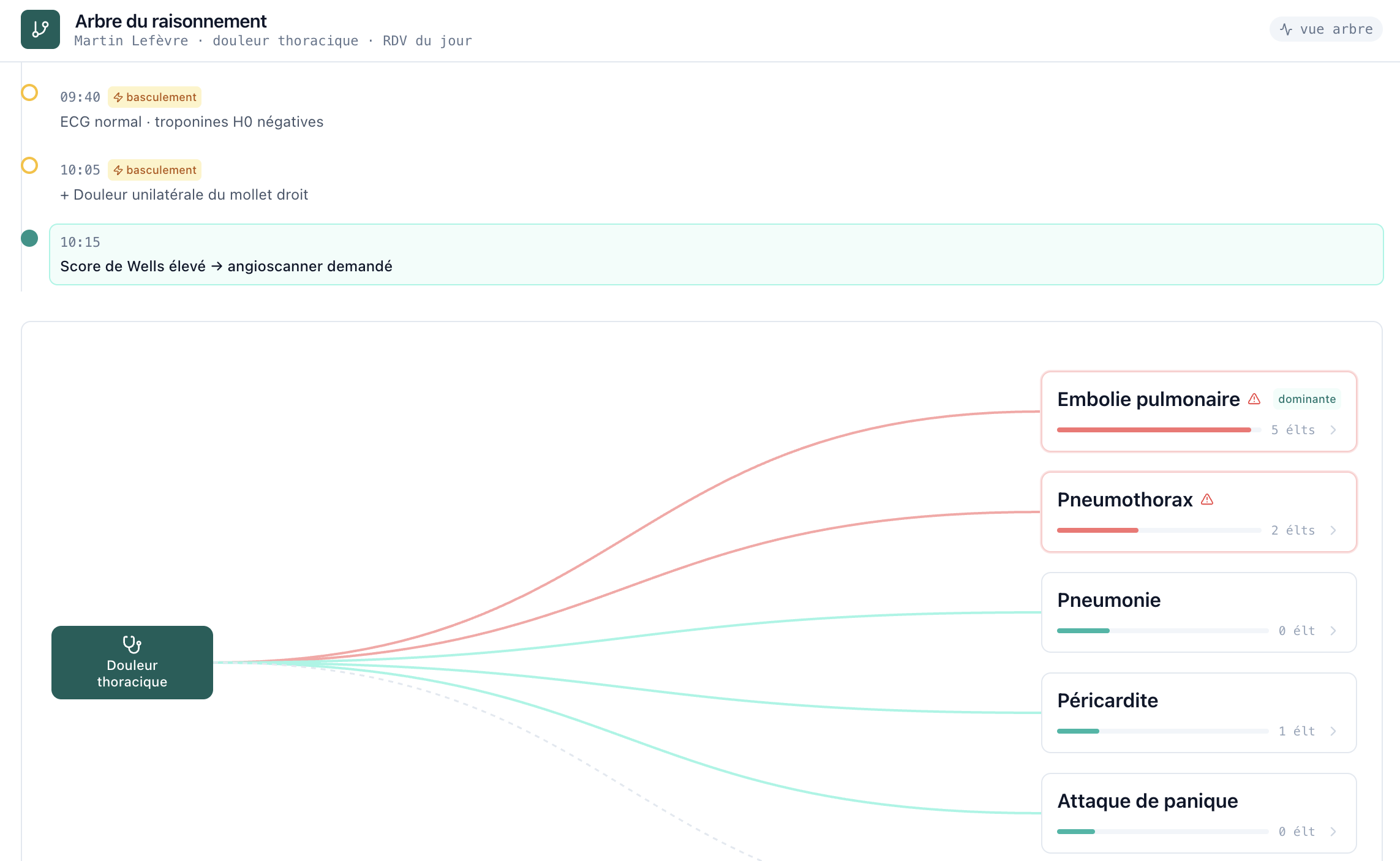
The view that adds time. The differential has a past. The tree replays how the reasoning evolved entry by entry, and the agent flags the pivots — the moments the picture swung hard. Every node is traceable: gathered elements, sources, and for a dismissed hypothesis, the reason for dismissal. You can go back to an earlier state: if a lead turns out wrong, the physician restarts from the moment before. Clinical accountability stays documented and reversible.

Going back archives the future rather than erasing it — nothing is lost, everything stays auditable. A parallel-branch variant remains an open avenue: more powerful, harder to read.
A good concept owns its grey areas.
A problem framed at the right level: cognitive and ethical, not cosmetic. UI in service of a safety stake.
The rare combination: deep functional understanding of an expert domain + modern UI execution + agentic fluency.
An assumed AI-native practice: designing agent interfaces by working with agents.